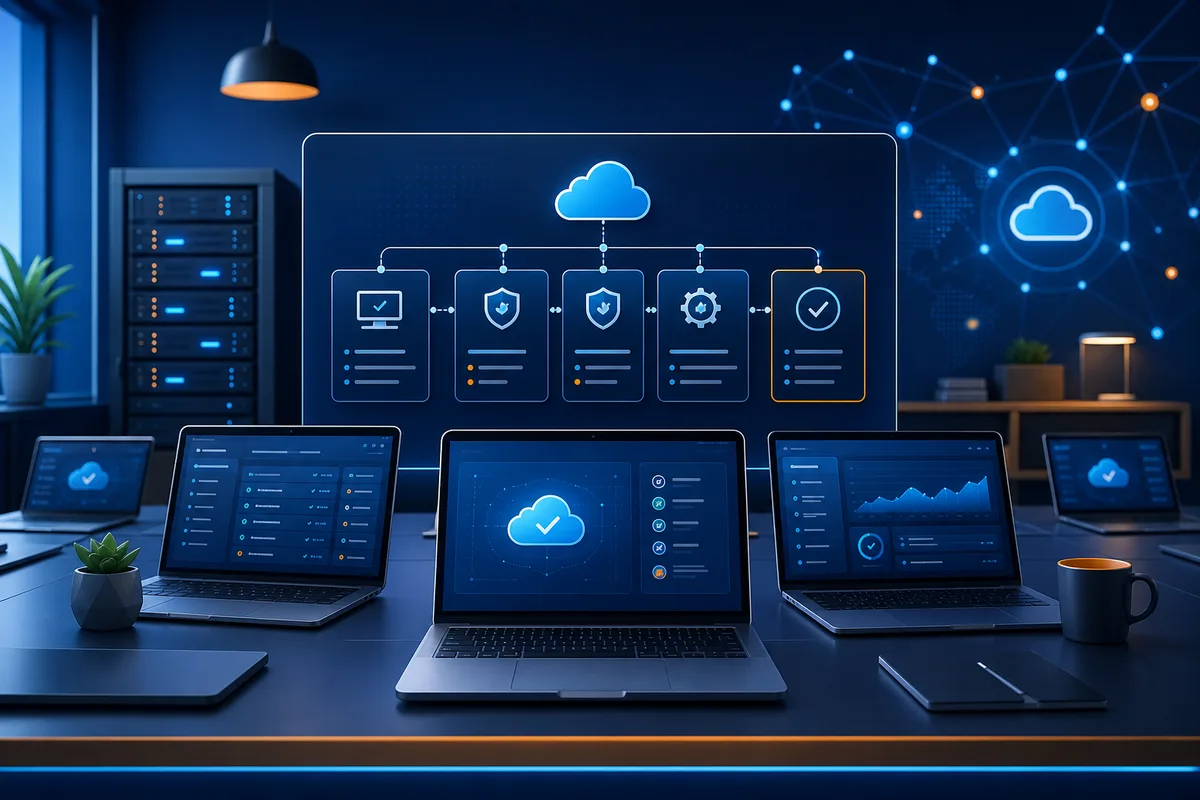
A managed desktop service lets a trusted IT provider take care of the applications, data, hardware, and software your people use every day. Instead of your team juggling installs, updates, security, and integrations, your provider oversees it all across your business, organization, or agency.

A strong managed service partner can go further than basic support. They can assess which applications your business relies on, how those tools connect to each other, and how your data is stored and protected. While software vendors like Microsoft and cloud platforms like AWS offer some managed services, those offerings are often limited in scope. That’s where a dedicated technology partner can make a real difference.

Because there are many options on the market, it’s critical to compare each provider’s capabilities, pricing model, and security standards. Taking the time to evaluate these areas helps you choose the partner that can actually support how your business works—today and as you grow.

Managed desktop services are often delivered through Desktop as a Service (DaaS). With DaaS, you can stream secure virtual desktops and applications from the cloud to your users’ devices—without the complexity of managing virtual desktop infrastructure (VDI) on your own. A Managed DaaS solution helps you manage your existing devices, hardware, and software while also strengthening endpoint security and monitoring.

In short, managed desktop services and DaaS give your team a secure, consistent, and reliable workspace, while your IT partner handles the heavy lifting behind the scenes.

How do Managed Service Work?

By partnering with a managed desktop services provider, you can offload the time, expertise, and investment required to support your organization’s IT environment. This approach can help you consistently improve service quality, increase efficiency, reduce costs, and free your internal IT team to focus on the projects that directly move your business forward. While offerings like Microsoft Managed Desktop exist, working with a dedicated managed desktop partner is often a more flexible, effective, and tailored option.

Different Types of Desktop-Managed IT Services

Common categories of desktop-managed services include:

  • Operating system and patch management
  • Software licensing
  • Cloud service management
  • Backup and recovery strategies
  • On-site support services
  • Endpoint security and mobile device management
  • Security monitoring
  • Application compatibility and integration
  • Infrastructure support
  • Help Desk support for end users

Benefits of Managed Desktop Services

With the right technology partner, a managed desktop environment can deliver a wide range of benefits. The list below is a starting point for the services you may want to consider.

  • Keeps your devices and end-user environments secure, standardized, and up to date.
  • Streamlines software licensing and helps ensure smooth integration between applications.
  • Enables users to access the specific tools, hardware, software, and applications they need—securely and consistently.
  • Simplifies the procurement process for hardware, software, and business applications.
  • Adds extra layers of protection against spear-phishing, spam, and other threats, along with enhanced filtering capabilities for platforms like Gmail and Microsoft 365.
  • Provides a clear, repeatable process for implementing updates and performing routine maintenance.
  • Delivers robust backup and recovery strategies at the desktop level so that, even if a device is compromised, lost, or stolen, your company’s critical data can be quickly restored.
  • Simplifies technology deployment and integration across your organization.
  • Offers responsive, effective end-user support that keeps your team productive.

Purpose of Managed Desktop Services

The core purpose of managed desktop services is to offload day-to-day IT tasks so you can stay focused on strategic business goals. By relying on an external team with deep experience in end-user systems and IT infrastructure, you gain better control, visibility, and reliability without adding internal overhead.

These services are especially valuable for small and mid-sized businesses, government agencies, and nonprofit organizations that need enterprise-grade IT support without building large internal teams. With the right partner, decision-makers can implement more robust, secure, and scalable processes.

A clear example of this value is in organizations running Enterprise Resource Planning (ERP) systems. The applications that connect to the ERP platform need frequent updates and careful management. In many ERP environments—particularly those involving advanced financial and cloud-based solutions—real-time, reliable support is critical to ensure users can respond quickly to changing markets and business conditions.

A trusted, holistic technology partner can be an invaluable resource in these scenarios, helping you maintain, secure, and optimize the systems your business depends on.

Why Managed Desktop Services Matter for Software Licensing

Software licensing is a major pain point for many organizations. When you multiply the number of applications, users, and departments, the time and effort spent on licensing, renewals, updates, and data storage can grow quickly.

It’s essential to ensure that your productivity suites, document management systems, and business-critical applications are properly licensed, configured, and maintained—both to protect your data and to safeguard your network.

Having an experienced technology provider manage ongoing licensing, renewals, and updates—across both commercial and proprietary software—helps you stay compliant, secure, and current, without overwhelming your internal team.